


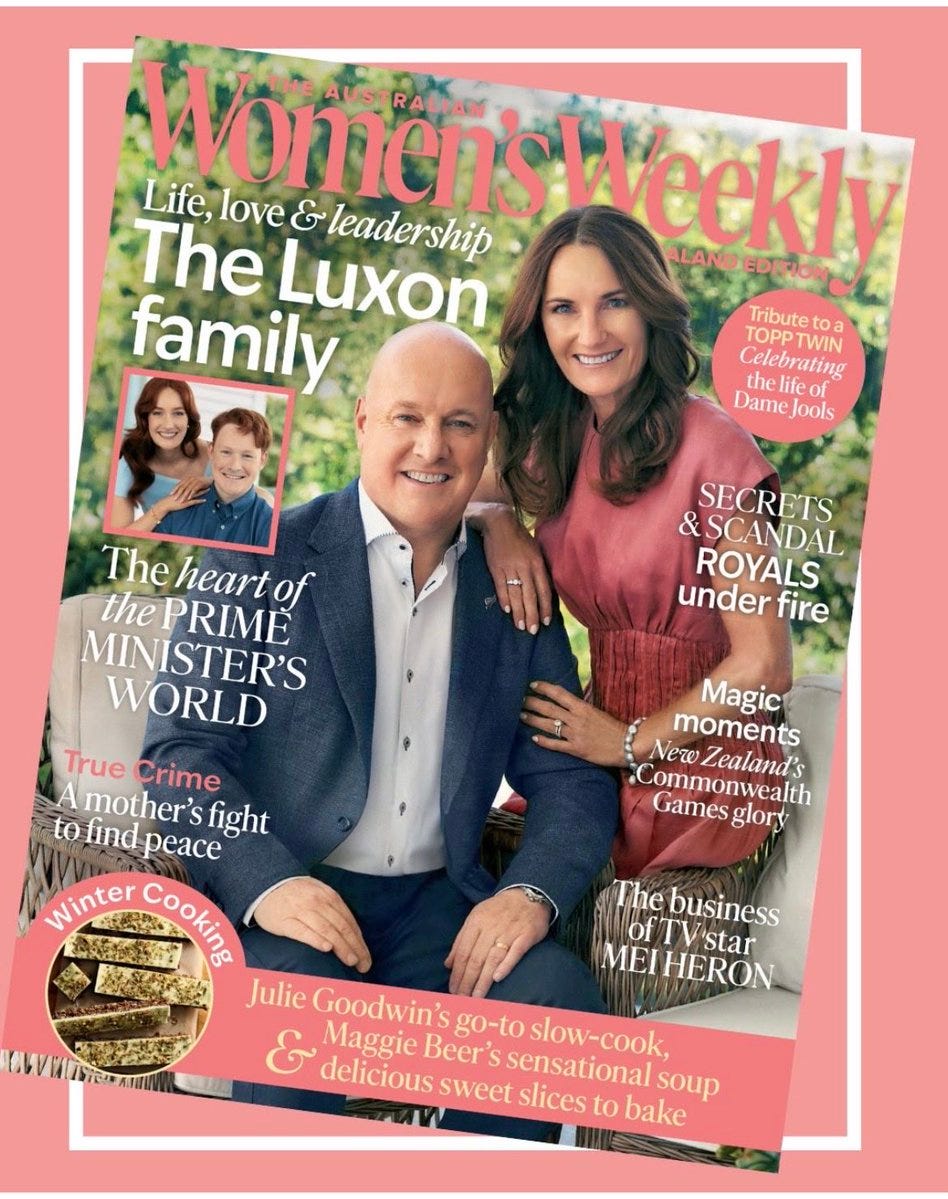
There’s a concept David Graeber spent his life dissecting: the performance of power. Not power itself — the actual boots-on-the-neck stuff — but the elaborate theatre states and ruling classes put on to make domination feel natural, inevitable, even warm. Kings wore crowns. Pharaohs built pyramids. Christopher Luxon does a magazine shoot.
Here’s what the Women’s Weekly soft-focus lens doesn’t show you. As of 2024, Luxon’s net worth sat somewhere between NZ$21 million and NZ$30 million, making him the second-wealthiest MP in Parliament. He has owned as many as seven properties — Auckland rentals, a Waiheke Island holiday home, a family home in Remuera — while simultaneously claiming $52,000 in taxpayer-funded accommodation allowances to live in a Wellington apartment he owned outright, mortgage-free. The Spinoff called it “the highest plane of passive income — truly the boss level.” He told reporters: “I get it, I’m wealthy.”wikipedia+2
He gets it. And then he builds a cover story about it.
Graeber, in Debt: The First 5,000 Years, showed that property — the accumulation of it, the enforcement of it — has always required a mythology. You don’t just need the land. You need people to believe you deserve the land. That your good fortune is a function of your good character. The Women’s Weekly exists, functionally, to manufacture that myth. It is a machine for converting class power into personality. The cover doesn’t say “landlord.” It says: Life, love & leadership.image.jpggoodreads

Meanwhile, in the real world this family photo is papering over: Budget 2026 nearly halved funding for food banks. The Family Violence support contracts — gone, $14 million cut by Oranga Tamariki alone. GP fees heading toward $100 a visit, forcing families to choose between seeing a doctor and paying the power bill. Patients dying in hospital waiting rooms under unsafe staffing conditions that this government’s hiring freeze helped create.psa+3
Austerity, as The Spinoff put it in June 2026, is for poor people, not politicians.thespinoff
Graeber had a term for this too — the inverse relationship at the heart of capitalist work: the more socially necessary your labour, the less you get paid for it. The nurses working understaffed wards at Dunedin Hospital. The food bank volunteers filling the gap left by Luxon’s Budget. The checkout workers at Countdown paying rent to a landlord who’s claiming a parliamentary accommodation subsidy. Inversely: the man on the cover, whose primary economic contribution to New Zealand has been owning houses in a market his own party keeps inflated.thespinoff+2
The magazine’s pull quote is “the heart of the Prime Minister’s world.” That heart beats for capital gains. It beats for property speculation. It beats for the kind of person who can sell a Wellington apartment for $890,000 profit while telling the country it needs to tighten its belt.reddit
Graeber was an anarchist. He didn’t believe in waiting for better kings. He believed the first step was seeing through the theatre — understanding that what gets presented as natural authority is usually just well-dressed theft, photographed nicely for a magazine rack.
So next time you see this cover in the waiting room of a GP surgery you can barely afford to visit: look at it clearly. That’s not a family. That’s a balance sheet in a blazer. And the magazine is the frame.
Key Takeaway: Every ruling class needs its mythology. Ours comes with a Women’s Weekly spread. Don’t buy it — literally or figuratively.