

“A rhizome has no beginning or end; it is always in the middle, between things, interbeing, intermezzo.”
— Deleuze & Guattari, A Thousand Plateaus
Before we get into it, a rhizome is a plant stem.
Not the kind that grows upward in a nice neat line toward the sun. No — this one grows sideways, underground, in every direction at once, connecting with everything, starting again if you cut it, producing new shoots wherever it pleases. Think ginger. Think bamboo. Think kikuyu grass - you never get rid it no matter how many times you try.
Gilles Deleuze and Félix Guattari — two French philosophers with a lot to say about capitalism and very little interest in being easy to read — used the rhizome in their 1980 masterwork A Thousand Plateaus as a metaphor for how knowledge, power and even people actually work. Not like a tree — not hierarchical, not with a single trunk and authorised branches growing from the top down. But like that underground root network: no fixed centre, no single entry point, no one place where “the truth” lives.
Here’s the thing: most of our institutions — schools, governments, corporations, universities — are trees. One trunk, with multiple branches. One set of authorised roots. One boss at the top who decides what counts as knowledge and who gets to have it. The teacher pours knowledge into the student like water into an empty cup. Brazilian educator Paulo Freire called this the banking model of education — the idea that learners are empty vaults waiting to be filled by an expert. It’s not education. It’s compliance training, just as all systems which rely on captivity and indoctrination require - there are walls, boundaries, and limits.
The rhizome says: nah, well, NAH!!!
Enter te-pa
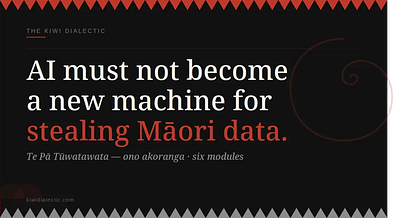
te-pa.org — Te Pā Tūwatawata is an ecosystem, free to enter (exit) and targets Māori data sovereignty and AI as the next frontier. It’s multilingual, beautifully designed (even if I do say) and pulls no punches. The core argument? That AI has become the latest machine for what Māori call raupatu — confiscation. Not of land this time, but of language, of faces, of waiata, of stories — all fed into machine learning models without consent, without benefit, without so much as a please.
But here’s where it gets interesting. Te Pā Tūwatawata isn’t just a course about a problem. It’s structured as the solution. The entire site — it’s six thinkers, free modules, teaching toolkit, sticker campaigns, its manifesto sections, its rhizome framework PDF — is built on explicitly rhizomatic logic. No single entry point. No prerequisites. No hierarchy.
You can start at Module 3. You can start at the sticker page. You can start by reading the kōwhaiwhai symbolism and end up three hours later down a rabbit hole about Māori data governance law. The community is the curriculum. The ecosystem is the course.
The Ecosystem — What We’re Actually Talking About
Te Pā Tūwatawata doesn’t stand alone. It’s one node in a larger network — part of The Kiwi Dialectic publishing ecosystem, which includes:
A Substack publication for long-form political education.
Twitter/X threads and meme campaigns using the hashtags #KiwiDialectic #TinoRangatiratanga #MāoriDataSovereignty
Downloadable teaching PDFs under Creative Commons, free to print, copy, and share
A rhizome theory framework — He Pakiaka Kei Raro (The Web) — drawing on Deleuze, Freire, Graeber, and Kropotkin.
Print-ready street stickers with QR codes linking back to the course
A campaign to establish Te Pā Tūwatawata as a registered charitable trust, with kaitiaki seats reserved for each language, community, all hosted on one site.
Every piece links to every other piece. Every sticker on a lamp post is an entry point. All indigenous languages, everywhere. Every tweet is a line of flight back to the source material. This is the rhizome in action — not as a metaphor, but as a strategy and a pedagogical architecture at the same time.
Why This Matters: The Tree vs The Rhizome
Let’s get concrete.
Deleuze and Guattari described arbolic thinking or tree thinking, as the default mode of Western knowledge systems. There’s a root (foundational truth), a trunk (authorised institution), and branches (approved versions of that truth). Binary. Hierarchical. You either have the qualification or you don’t. You’re either in the system or you’re not.
If you look around - The Beatles were all unemployed, and on the dole when they created the music of a century. Imagine how many people there are sitting outside the system. How much talent is wasted? And why?
Rhizomatic thinking cuts across all of that. In education terms, it means:
Any point connects to any other point — you don’t have to start at the “beginning”.
Knowledge is negotiated, not deposited — learners are co-creators, not passive recipients.
There is no canonical path — learning can move in any direction, at any speed, responding to what’s actually happening in the world.
Lines of flight are encouraged — when conventional thinking runs out of road, you find another route.
Canadian educator Dave Cormier, who brought rhizomatic learning into the digital age, described it simply: “the community is the curriculum”. You don’t need a textbook if you have a live, engaged community generating, questioning, and sharing knowledge in real time. That’s exactly what Te Pā Tūwatawata is trying to build.
Now Here’s the Plot Twist: Whakapapa Was Already There
Here’s something the European philosophers didn’t fully reckon with: Māori already had a rhizomatic knowledge system. It’s called whakapapa.
Whakapapa is usually translated as “genealogy” — but that undersells it. It’s not just a family tree. It’s a web connecting humans, non-humans, the spiritual world, ecological systems, and the cosmos. You can enter the network at any node. The past is mua — in front of you, visible, guiding you forward. You walk backwards into the future with your eyes fixed on what came before.
As a knowledge system, whakapapa has been described as a mind map, a folk taxonomy, and a cognitive gestalt — a way of organising complex arrays of information where everything is held in relationship to everything else. Researchers from the MAI Journal describe how whakapapa can function as a research methodology: not linear, not extractive, but relational — tracing the threads that connect people, places, ideas, and responsibilities across time.
This is why the framing on te-pa.org is so sharp. When it says “Whakapapa is not a family tree — it is a web,” it’s not borrowing Deleuze. It’s pointing out that Deleuze was, in some sense, catching up to indigenous ways of thinking that predate him by centuries. The rhizome wasn’t invented in Paris in 1980. It was already growing in Aotearoa - and we’re just learning that now.
Comparing the Rhizome Family: You’re in Good Company
Te Pā Tūwatawata sits within a much wider tradition of rhizomatic and connected pedagogies. Here’s how they relate:
Deleuze & Guattari, Dave Cormier
No centre, no hierarchy, community as curriculum.
Explicit structural framework of the whole site.
Critical Pedagogy
Paulo Freire Banking model vs problem-posing; learner as co-creator. Teacher’s Handbook built on Freirean generative word method.
Kaupapa Māori Graham Smith, Linda Tuhiwai Smith.
Māori-led, tikanga-grounded, transformative praxis. Foundation of governance, content framing, and assessment.
Whakapapa as Network
Te ao Māori epistemology. Relational web across time, space, human and non-human. Built into site structure — enter at any node.
Indigenous Pedagogies (global)Battiste, Blackstock, LearningBird
Relational, experiential, community-embedded, place-based. Mirrored in module activities, wānanga model, kaitiaki trust.
Connectivist MOOCs George Siemens, Stephen Downes
Learning as network formation; knowledge distributed across connectionsEchoed in multi-platform distribution strategy.
Mutual Aid / Horizontal Organising Kropotkin, Graeber
Non-hierarchical cooperation; collective self-organisation.
Te Pā Tūwatawata doesn’t cherry-pick. It weaves with whakapapa, like unaunahi the interlocking fish scales whose motif runs through the entire site’s design language.
Each tradition reinforces the others. Freire’s problem-posing meets Kaupapa Māori transformation meets Deleuzian rhizome meets Kropotkin’s mutual aid — and somehow it all holds together because the tikanga is doing the structural work underneath.
What Makes a “Line of Flight”?
One of the most useful ideas from Deleuze and Guattari’s toolkit — and one the Te Pā rhizome PDF develops directly — is the concept of lines of flight (lignes de fuite).
A line of flight is not escape. It’s not running away and hiding. It’s a movement that creates new terrain. When something escapes the control of the dominant system, it doesn’t just disappear — it deterritorialises, makes space, opens possibilities that didn’t exist before. And it’s creative and innovative - moving in all directions at once.
Look at the examples from Aotearoa’s own history:
Kōhanga reo was a line of flight — te reo Māori had been nearly destroyed by the colonial school system, and rather than fighting that system from the inside, communities built their own. The language found a new root.
Te Hiku Media building their own voice AI — using community-owned recordings, their own servers, their own consent protocols — rather than handing Māori speech data to Silicon Valley. That’s a line of flight in real time.
Te Pā Tūwatawata itself is a line of flight. Rather than petitioning universities to teach data sovereignty, or waiting for the government to regulate AI extraction, someone just built the course and made it free. Why not?
This is the practical political value of rhizomatic thinking. You don’t capture the tree. You spread underneath it.
The Working-Class Case for Rhizomatic Learning
Let’s be straight about who the banking model of education serves. It’s not you. It’s not your whānau. It’s not the worker on the factory floor or the nurse on the night shift, nope, the single parent trying to understand why their kid’s school is underfunded, no, or the person who left school at 16 because school never made them feel like their knowledge was worth anything. The runaway. The creative thinker.
The banking model needs you passive. Needs you to believe that knowledge lives in their books, their institutions that charge fees you can’t afford, dispensed by experts who speak in languages designed to keep you out. The debt model expressed by Graeber and Freire.
It’s not a conspiracy — it’s how hierarchical systems reproduce themselves. Get bigger, fatter, more rapacious until eventually, they explode - and brain matter splatters with the blast of a shotgun. Like Gaza. Like the cost of living crisis, the housing crisis and numerous other crisis. It’s endemic - the cancer spreads and implodes.
Freire wrote that education is never neutral — it either reinforces the dominant order or it challenges it. Kaupapa Māori, indigenous pedagogies — they all land on the same side of that line. They say: you already have knowledge. Your experience is data. Your community is curriculum. Start where you are.
Te Pā Tūwatawata does this with elegance. As one might expect!
Module 1 doesn’t start with a lecture on the history of data governance. It starts with an activity: draw a whakapapa of your own data.
AI Use Disclosure:
Research assistance and initial drafting support for this article was provided using AI tools. All claims, sources, framing and editorial judgements were verified and finalised by the author.
Author Disclosure:
The author publishes The Kiwi Dialectic, a socialist political education platform based in Aotearoa New Zealand. This article discusses te-pa.org
(Te Pā Tūwatawata) a project within the same publishing ecosystem. This relationship is disclosed in the interest of transparency. No financial compensation was received for coverage of any platform, tool, or organisation mentioned herein.
Published under CC BY-NC-SA 4.0 — The Kiwi Dialectic / kiwidialectic.com
This entire post is AI-generated nonsense. Incredibly embarassing to read. Fancy claiming that you're supporting Māori data sovereignty when you're generating slop about our culture with commercial AI tools. Shame.